
This article was long overdue. World Food Day feels like the right moment to finally tell it, especially given its current theme: “Innovate Today. Nourish Tomorrow.”
Every year on World Food Day, the world reflects on how food systems shape our health, our environment, and our future. The theme is a reminder that sustainable food production is an practical, community‑driven effort and attainable goal that starts with farmers, consumers, and local institutions willing to experiment and work together.
In North Macedonia, the story began nearly three decades ago, brought back to me by a fading receipt I stumbled upon in an old notebook: it shows a payment (two installments) of 120 Deutsche Marks for a share of organic produce in a Bio-Agro Cooperative of Consumers and Producers.
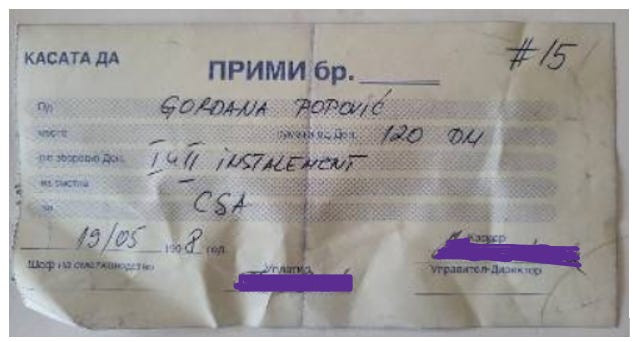
Dated 1998, the receipt represents one of the earliest community‑supported agriculture (CSA) pilots, through a USAID‑funded project implemented by ACDI/VOCA. Long before “farm‑to‑table” became a development trend, this pilot blended knowledge transfer, farmer support, and community engagement in ways that still resonate today.
A Cooperative Born from Knowledge Exchange
The Bio Agro cooperative and community for sustainable farming and organic food emerged from a structured set of support activities that promoted Integrated Pest Management (IPM) and organic food production to Macedonian farmers:
-
Technical assistance from U.S. volunteer experts, ACDI/VOCA staff (including myself, colleagues and our manager), and local expert consultants;
-
Targeted peer‑learning programs and study tours exposed farmers to leading organic and IPM practices in the United States including training and field demonstrations at the University of Tennessee, CalPoly and University of California at Davism, led by experts – professors, extension agents and farmers.
-
Exchange visits to Austria, Hungary, Bulgaria, Greece (i.e., with an American Farm School in Thessaloniki) expanded practical insights on IPM and organic production and added exposure to regulatory solutions, certification systems, and field‑to‑market links.
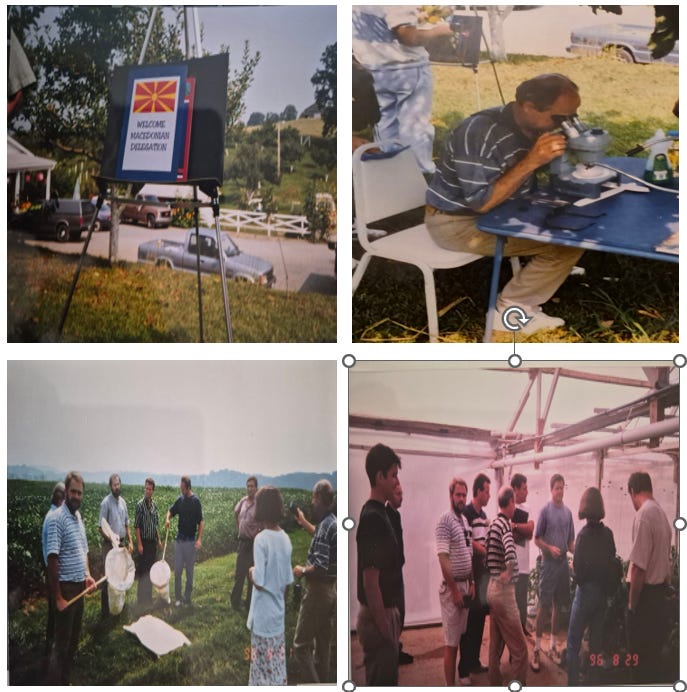
Locations: Tennessee, California (1996); Photo Credit: My archives.
These knowledge‑exchange visits — which I led and interpreted — were deliberately practical, intensive, and designed for immediate application. The project followed a principle that still holds today: knowledge exchange matters when it leads to action. Practitioners who gained exposure abroad were supported at home to introduce improved or entirely new practices.
A Community-Supported Agriculture Model Ahead of Its Time
Community Supported Agriculture (CSA), a type of direct marketing, is a community of individuals who pledge support to a farm operation so that the farmland becomes, either legally or inspirit, the community’s farm; with the growers and consumers providing mutual support and sharing the risks and benefits of food production.
The CSA cooperative in North Macedonia under the auspices of a larger agribusiness support project funded by USAID began with 40 members, mostly international staff in Skopje, who subscribed to weekly or seasonal shares of organic legumes, vegetables, and fruits. These were grown by 3 contract farmers who received technical assistance through the project.
Within a year:
-
Consumer membership doubled and included eager local citizens
-
The number of contract farmers doubled
-
Members participated directly in farm activities – planting, weeding, mulching, harvesting, transport, and presentations.
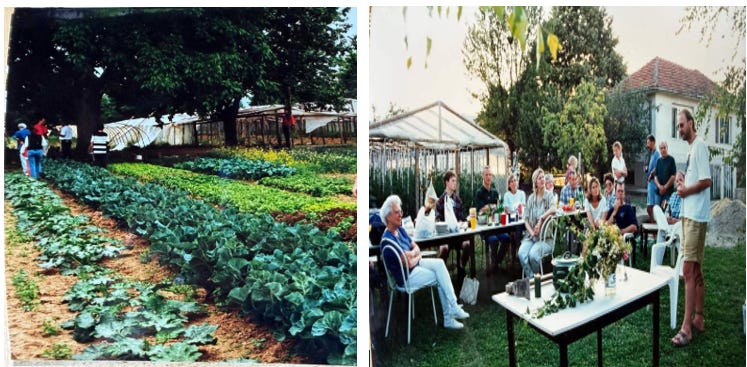
Location: Village in Strumica (1998); Photo credit: Annie Mozer, CSA member
This was a supply chain and, even more importantly, a community. And it demonstrated something critical: there was real demand for organic produce, even before it had a legal and certification framework for it.
What Integrated Pest Management (IPM) Means and Why It Matters
IPM is an ecological approach to pest control that prioritizes prevention, monitoring, and environmentally friendly methods before resorting to chemicals.
Its four core principles:
-
Prevention through healthy soils, crop rotation, resistant varieties, and field hygiene
-
Monitoring and early detection
-
Biological and mechanical controls first
-
Targeted chemical use only as a last resort
Environmental Benefits of IPM
IPM in North Macedonia: A Quiet but Important Success Story
IPM is a knowledge‑based, systems‑driven approach that strengthens agricultural ecosystems by reducing chemical pollution, protecting biodiversity and pollinators, improving soil health, lowering the risk of pesticide resistance, and minimizing exposure for both farmers and consumers. By prioritizing ecological balance and long‑term resilience, IPM helps farms adapt more effectively to climate pressures while maintaining productivity and environmental integrity. It is, ultimately, a pathway toward agriculture that nourishes both people and the planet.
Since a 1998 Law on Plant Protection[1], North Macedonia has gradually integrated IPM into the regulations, the agricultural extension services and farmer training programs. Key trends include:
-
IPM embedded in national agricultural policy through EU alignment
-
Strong adoption among fruit and vegetable producers
-
Demonstration farms and donor projects (USAID, IME, GIZ, UNDP) driving farmer training
-
Export markets pushing demand for residue‑free production
There is still a need for specialized advisors, better monitoring systems, and stronger incentives for transitioning away from chemical‑intensive practices.
A Pilot That Helped Shape National Policy
The pilot’s success demonstrated early demand for organic production and helped initiate the development of organic legislation in cooperation with the Ministry of Agriculture, Forestry and Water Economy (MAFWE) and the Faculty of Agricultural Sciences and Food in Skopje.
It showed policymakers and that organic food production was viable on a limited scale and that there was consumer interest and readiness for organic produce.
Where The Organic Sector Stands Today
North Macedonia’s organic sector[2] remains a small, under‑leveraged segment of its agricultural economy. It has developed strategies, institutional frameworks, and financial incentives (subsidies), still the data shows a system maintaining small capacity rather than advancing toward national goals.
Organic operators (2022–2024):
• 913 in 2022 • 913 in 2023 • 904 in 2024
A slight decline that reflects stagnant entry and quiet exits.
Certified organic land (2024):
• 4,616 ha under organic cultivation
• 4,376 ha actively farmed
Of the total arable land (506,586 hectares) in the country, only 0.91% is certified organic. It’s a fraction of the country’s potential and well below the trajectory needed to reach the 2% national target by 2027.
Production structure:
• 40% cereals • 22% fodder • 20% orchards • 13% industrial/aromatic/medicinal plants
• 4.65% vineyards • 0.35% vegetables
High‑value segments (medicinal plants, vineyards, vegetables) remain marginal, reinforcing continuity over innovation.
Livestock: Organic livestock is dominated by sheep (88.11%), reflecting tradition rather than strategic market positioning.
Beekeeping is the only subsector showing real momentum:
• 10,072 hives (2022) • 10,944 (2023) • 11,169 (2024)
Producers are clearly gravitating toward beekeeping.
Financial incentives:
The state provides generous organic subsidies i.e., 30% to 100% above conventional payments, plus certification and testing support, and targeted incentives for processing and export.
North Macedonia’s organic sector has potentials and needs stronger incentives, market development, value‑chain integration, and a shift toward higher‑value crops.
Why the CSA Cooperative Still Matters — and How the Story Came Full Circle
Bio Agro was a prototype for what sustainable agriculture in North Macedonia could become:
-
A community‑based model linking consumers and farmers
-
A demonstration of demand
-
A platform for farmer learning
-
A catalyst for policy development
A Personal Return to Community Agriculture
More than two decades later, in 2020, my family and I became members of a local CSA for organic food (“Dobra Zemja” meaning “Good Land”) in Skopje. Week after week, we enjoyed boxes of locally grown organic produce—fresh, seasonal, and rooted in the same principles we piloted back in 1998.
It felt like a full‑circle moment. The seeds planted through the Bio Agro cooperative had taken root in ways we could not have predicted.
Looking Ahead: To accelerate progress, the country would benefit from:
-
Stronger financial incentives for organic conversion and IPM scaling up.
-
Enhanced extension services with specialized sustainable agriculture advisors.
-
Market development programs linking farmers to retailers, processors, and CSAs.
-
Support for farmer cooperatives and producer groups.
-
Consumer awareness campaigns on health and environmental benefits
The Bio Agro community proved that when farmers, experts, consumers, and institutions collaborate, sustainable farming and food production can flourish.
♻️ Sustainability as a Long‑Game of Delivery and Design
The Bio-Agro cooperative pilot demonstrated that meaningful impact does not happen at the moment of project delivery; rather it evolves through time. The pilot created long‑term value by building farmer capacity, strengthening knowledge systems, generating consumer demand, and ultimately influencing national policy. Its legacy shows that sustainability is a design choice made early, carried through implementation, and proven years later in how communities adopt, adapt, and continue the practices introduced. When projects embed this thinking from the start, they have the power to shape entire sectors.
References:
Agricultural Extension Service (2025): Law on Organic Agriculture | Available at: Link
Eurostat (2024) – EU Organic Farming Statistics; Available at: https://ec.europa.eu/eurostat/web/products-eurostat-news/w/ddn-20240619-3
FAO (2026): Integrated Pest Management: Principles and Guidelines: Available at: https://www.fao.org/pest-and-pesticide-management/ipm/integrated-pest-management/en/
Ministry of Agriculture, Forestry and Water Economy (2025) – Agriculture and Rural Development Report 2024 – Available at: https://portal.mdt.gov.mk/post-body-files/godisen-zemjodelski-izvestaj-za-2024-godina-file-g7XQ.pdf
Moja Farma, What is Integrated Pest Management (2021), Available at: LINK
Project Management Institute (2026): The PMI® GPM® Practice Guide for Sustainability in Project Management, Available at: https://www.pmi.org/standards/gpm-practice-guide-for-sustainability-in-project-management
State Statistical Office (2026): Organic production, 2023
State Statistical Office (2026): Statistical Survey on Organic Production 2022
Swiss IME Programme, Sustainable Agribusiness Practices in North Macedonia, 2023; Available at: https://www.sdc-foodsystems.ch/en/agribusinesses-in-north-macedonia-go-green
[1] Law on Plant Protection, Official Gazette No.25/98. Available at: https://faolex.fao.org/docs/pdf/mac159914.pdf
[2] Agriculture and Rural Development Report 2024 (MAFWE 2025), Available at: https://zpis.gov.mk/Upload/Documents/Izvestaj-za-zemjodelstvo-i-ruralen-razvoj-2024-god