
Every PISA cycle offers countries a chance to understand how well their education systems are preparing young people for a rapidly changing world. For the Western Balkans, the 2025 results reaffirm a pattern that has been visible for more than a decade: students across the region continue to perform below OECD averages in science, reading, and mathematics.
This is not a crisis narrative. It is a development reality, one that calls for steady, long-term investment in human capital, stronger public sector capability, and closer alignment with SDG 4 (Quality Education) and the broader SDG framework.
The region has made progress in access, inclusion, and policy reform. But PISA 2025 shows that foundational learning remains the area where improvement is most needed.
A Region Still Catching Up — With Variation, But Shared Challenges
Across the Western Balkans, PISA 2025 scores remain below OECD benchmarks:
-
Science: mid‑350s to mid‑430s (OECD average: 482)
-
Reading: low‑340s to low‑420s (OECD average: 461)
-
Mathematics: mid‑350s to low‑430s (OECD average: 463)
There is meaningful variation. Albania, Montenegro, and Serbia consistently score higher than Bosnia and Herzegovina, North Macedonia, and Kosovo — often by 40–60 points. But all countries share a common challenge: foundational learning outcomes are not yet aligned with the expectations of modern labor markets or the EU acquis.
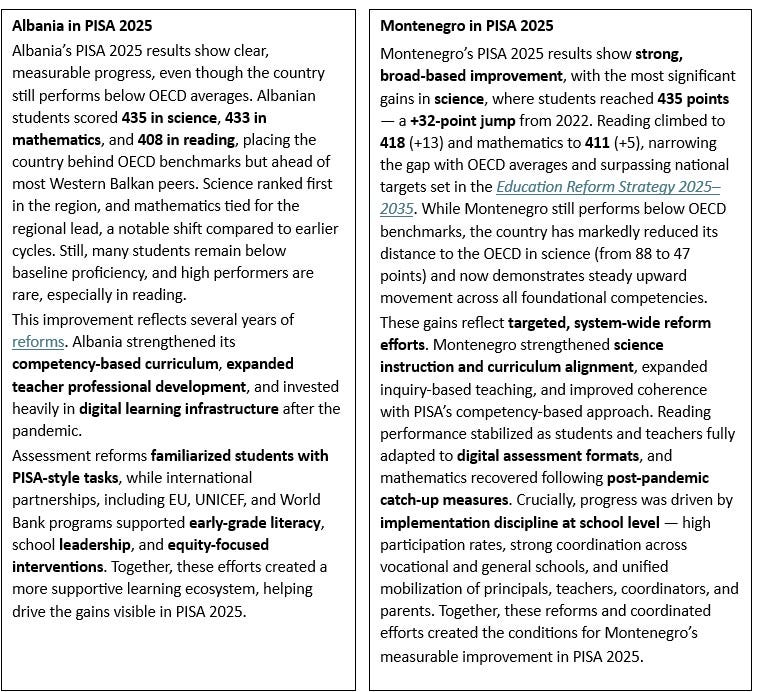
The region also has:
-
A small share of top performers, limiting the pipeline for advanced STEM fields
-
A large share of low performers, indicating persistent early-grade learning gaps
These patterns matter because they connect directly to SDG 4.1, which focuses on minimum proficiency in reading and mathematics.
Human Capital and the SDGs: Why Foundational Learning Matters
Beyond an educational metric, foundational learning is a building block for multiple development outcomes:
-
SDG 8 (Decent Work & Economic Growth): Higher-level skills correlate with higher added value and higher productivity.
-
SDG 9 (Industry, Innovation & Infrastructure): STEM readiness underpins digitalization and innovation.
-
SDG 10 (Reduced Inequalities): Early learning gaps often mirror socioeconomic divides.
-
SDG 13 (Climate Action): Green transition requires technical and scientific literacy.
-
SDG 17 (Partnerships): Education reform depends on coordinated, multi-partner support.
The Western Balkan countries have made progress on access and equity, but PISA shows that quality, the core of SDG 4, remains the area where the region must accelerate.
Understanding the Drivers: Structural, Not Sudden
The factors behind underperformance are well-documented and familiar across the region:
-
Curricula not fully aligned with competency-based learning (SDG 4.7)
-
Gaps in teacher preparation (pre-service training) and continuous professional development (SDG 4.c)
-
Limited use of formative assessment
-
Fragmented governance and uneven implementation of reforms
-
Underinvestment in early childhood education (SDG 4.2)
-
Public sector capability constraints in planning, budgeting, and data use (SDG 16)
None of these are dramatic failures. They are structural challenges that require sustained, coordinated action.
A Practical, SDG-Aligned Reform Agenda for the Next 12–36 Months
The Western Balkans do not need sweeping reinvention. They need consistent, evidence-based improvements that strengthen foundational learning and align with SDG 4 targets.
A. Strengthen Foundational Learning (SDG 4.1 & 4.2)
-
Structured literacy and numeracy programs in early grades
-
Diagnostic assessments at Grades 3 and 6
-
Expanded ECE access, especially in rural and low-income communities
B. Transform Teaching Quality (SDG 4.c)
-
Modernized pre-service training
-
Coaching and mentoring models
-
Reduced administrative burden for teachers
-
STEM teacher scholarships and career pathways
C. Modernize Curriculum and Assessment (SDG 4.7)
-
Competency-based curriculum aligned with EU key competences
-
Digital formative assessment tools
-
School-level data use for improvement planning
D. Strengthen Governance and Accountability (SDG 16)
-
Transparent school performance frameworks
-
Increased school autonomy with targeted support
-
National learning recovery programs
-
Improved public sector capability for implementation
E. Mobilize Financing for Human Capital (SDG 17)
-
Prioritization of education in public investment and IPA III
-
Results-based financing for learning outcomes
-
Multi-year human capital compacts with IFIs
This is a realistic agenda, not a dramatic one. It builds on existing reforms and focuses on implementation discipline.
The Role of Development Partners: Coordination Over Fragmentation
The Western Balkan countries benefit from strong engagement by international partners. The next step is ensuring that support is coordinated, evidence-based and aligned with national priorities.
-
World Bank / EBRD: governance, digitalization, financing
-
EU Delegation: accession alignment and IPA III windows
-
UNDP | UNICEF: foundational learning and school leadership
-
UNESCO: curriculum and assessment modernization
-
Global Trust Funds: Global Partnership for Education (GPE), UNICEF financing windows, Education Cannot Wait (ECW)
These mechanisms offer long-term financing and technical expertise, essential for SDG 4 progress.
A Balanced Conclusion
PISA 2025 does not signal a crisis. It signals continuity: the Western Balkans have made progress, but foundational learning remains the area where improvement is most needed.
The region has institutions, partners, and policy frameworks to advance SDG 4. What matters now is steady implementation, stronger public sector capability, and sustained investment in teacher quality, early childhood education, and competency-based learning.
The Western Balkans are not starting from zero. They are building on a foundation that is already in place, and PISA 2025 simply shows where the next layer of work needs to happen.
PISA 2025 Results (Volume 1), Available at: https://www.oecd.org/content/dam/oecd/en/publications/reports/2026/09/pisa-2025-results-volume-i_5265bfb1/73451bc5-en.pdf