
Between work cycles and annual leave, Summer is a good time to pause, reflect, and invest in professional development. This year, I selected and focused on the following courses below on systematizing knowledge, sharpening analytical rigor, and deepening the foundations of evidence‑based development practice.
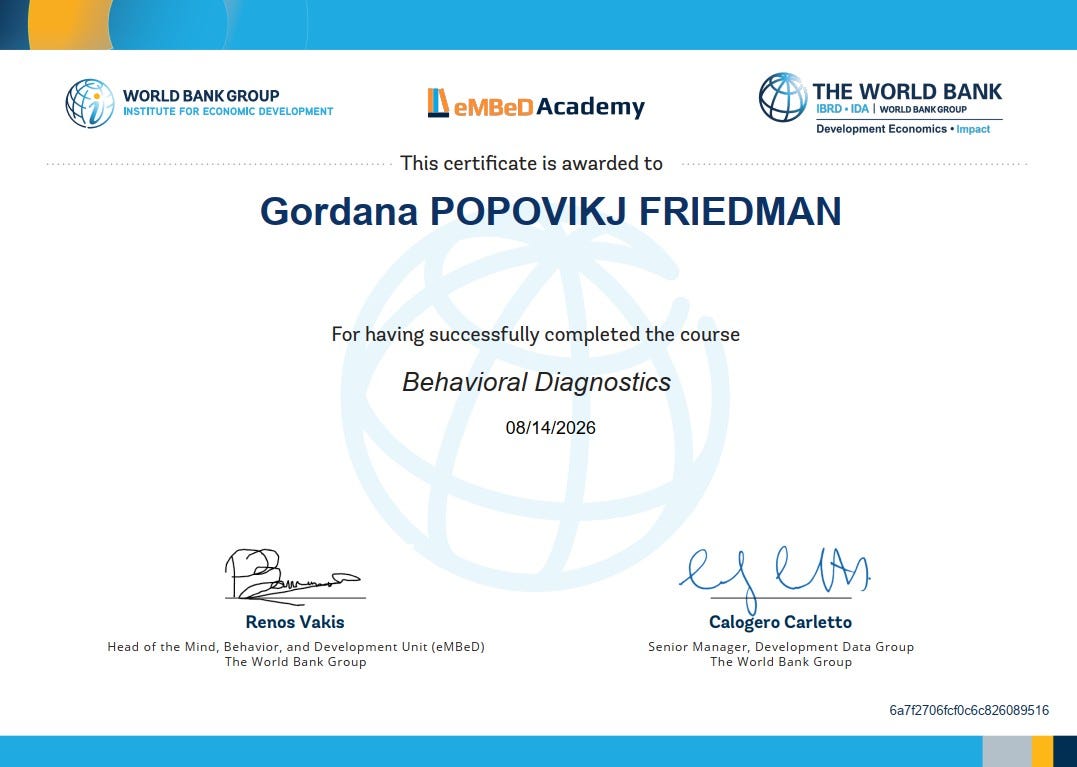
Behavioral Diagnostics for Public Policy — World Bank Institute for Economic Development
I’m grateful to the WB IED team for the opportunity to test this new e‑course in its beta version, and provide feedback. The course introduces a structured diagnostic process for identifying behavioral bottlenecks behind policy non‑compliance. It reinforces the importance of mapping user journeys, defining target behaviors precisely, and designing interventions that respond to real constraints rather than assumptions.
This e-course is follow-up on Fundamentals of Behavioral Science for Public Policy e-course also by WB’s Institute for Economic Development. For someone working across policy, private sector development, and institutional strengthening, this course adds a powerful analytical lens.
Migration and Climate Change — FAO eLearning Academy
This course explores how climate change shapes migration patterns and how mobility, in turn, influences resilience, livelihoods, and development outcomes. It provides a structured understanding of the economic, social, and institutional dimensions of climate‑related migration, linking global policy frameworks with practical programming approaches. It strengthens my ability to design interventions that leverage mobility, remittances, and community adaptation strategies for inclusive and climate‑resilient development, directly complementing my work in sustainable development and private sector engagement.
Knowledge Management for Emergency and Resilience Programming— FAO eLearning Academy
This course sharpened my ability to design knowledge systems that perform under pressure. It explores how information flows, learning loops, and decision‑support tools can be embedded into emergency and resilience programming.
The focus on operational KM, not just documentation, aligns strongly with my experience in project management and cross‑institutional coordination, helping transform knowledge into a strategic asset.
Knowledge Management Course: KM Systems and Wiki Setup – Udemy
I also completed this comprehensive yet practical Knowledge Management course designed to help managers and HR professionals to enhance information accessibility, foster a culture of knowledge sharing, manage a robust knowledge system and improve overall organizational efficiency. A great complement to the FAO KM training, reinforcing how good systems make learning accessible and actionable.
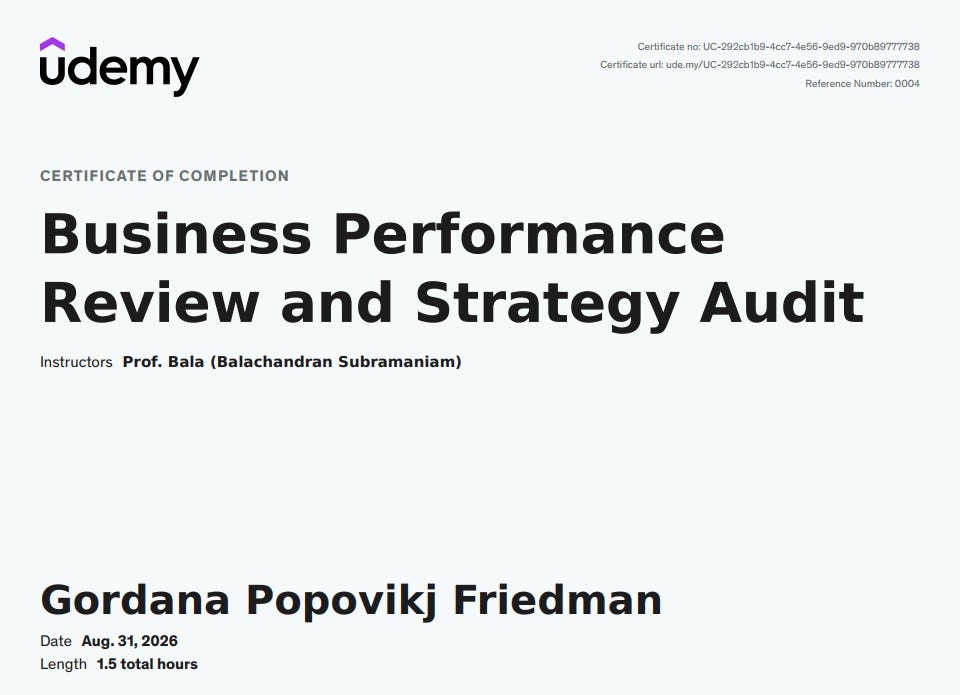
Practical Internal Audit, Controls & Risk Management | Business Performance Review and Strategy Audit — Udemy
These courses (2) strengthened my grounding in internal controls, risk assessment, and business performance review methodologies. They reinforced the importance of accountability, transparency, and structured evaluation all essential for managing complex portfolios, donor-funded projects, and institutional partnerships. It also complements my experience with procurement, safeguards, and results-based management.
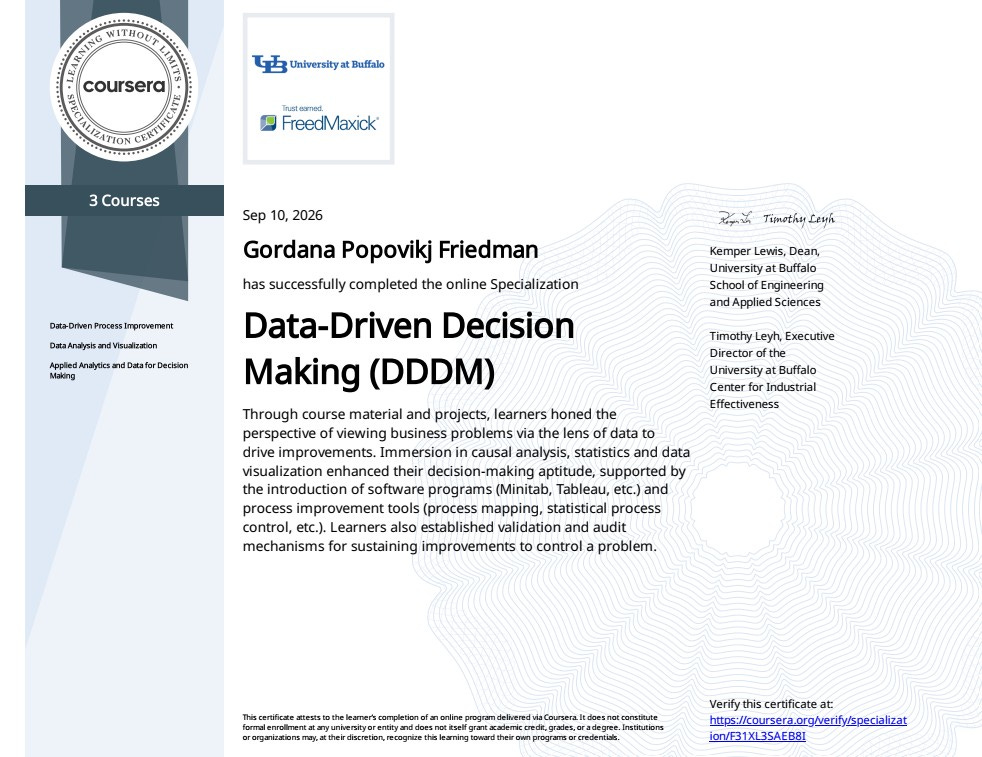
Data-Driven Decision Making Specialization — State University of New York (SUNY) Buffalo via Coursera
This specialization consists of three courses: Data-driven Process Improvement, Data Analysis and Visualization, and Applied Analytics and Data for Decision Making. It builds a comprehensive foundation for making decisions using data, analytics, and evidence. It covers data literacy, analytical frameworks, and practical tools for interpreting and communicating insights. For someone who already works with analytics, project data, and policy evidence, this specialization helps systematize the approach and strengthens the ability to translate data into strategic action.
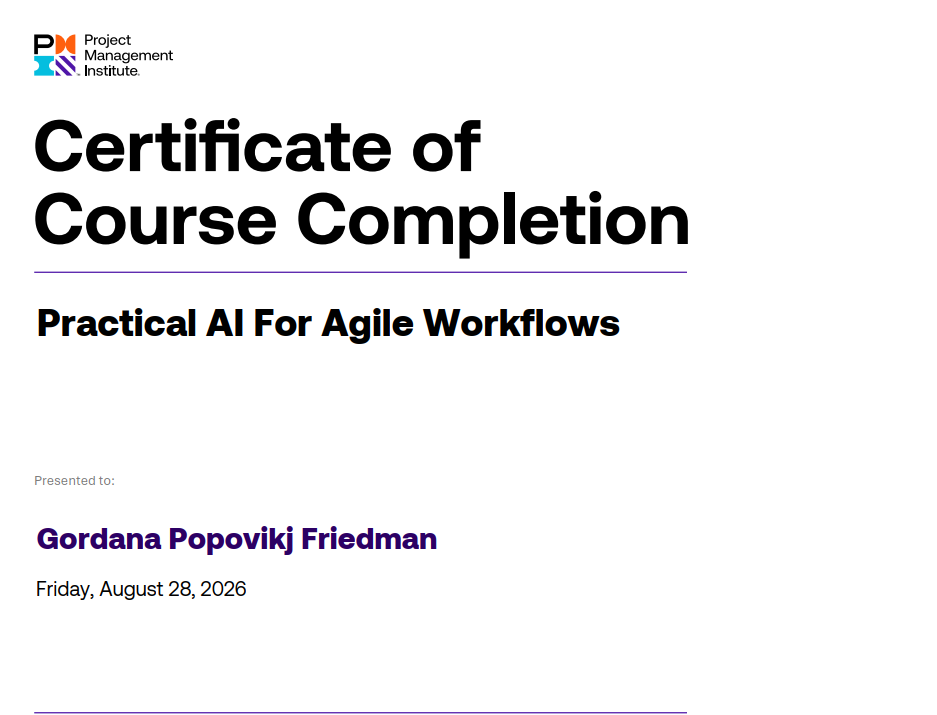
Practical AI for Agile Workflow – Project Management Institute (PMI)®
This course added a sharp layer to my summer learning by showing how AI can strengthen decision‑making, sprint planning, and cross‑functional collaboration in agile contexts. It breaks down where AI adds value, from automating routine backlog tasks to improving estimation accuracy and surfacing insights that help teams adapt faster. It connects AI capabilities with core agile principles: transparency, iteration, and continuous improvement. It reinforced my experience in knowledge systems and data‑driven decision making, while giving me a better understanding of how AI can be embedded responsibly and effectively into project workflows.
As a PMI® member, I look forward to the annual conference of PMI’s North Macedonia Chapter on 16 October 2026, entitled “Impact Over Output: Redefining Project Success”.
Common Thread: Systematizing Knowledge, Deepening Insight and Strengthening Practice
Across all five courses, a clear pattern emerges: a commitment to structured thinking, evidence‑based decision making, and the ability to design systems – behavioral, informational, institutional, or analytical, aimed at improving development outcomes.
Together, they build on my existing experience in sustainable development, blended finance, project management, and policy design. They deepen the analytical foundations, expand the conceptual toolkit, and reinforce the importance of rigorous, human‑centered, data‑driven approaches.
Beyond adding certificates, summer learning and reflection is about sharpening the craft. And this year’s learning journey has done exactly that.